
When PCOS is discussed, the talk is mostly about irregular periods, weight, acne and children. But in the clinic, many women quietly say something else too: “I feel ashamed of my body,” “I shrink back when my husband comes close,” “I just don’t feel desire.” This emotional and sexual side of PCOS is often ignored.
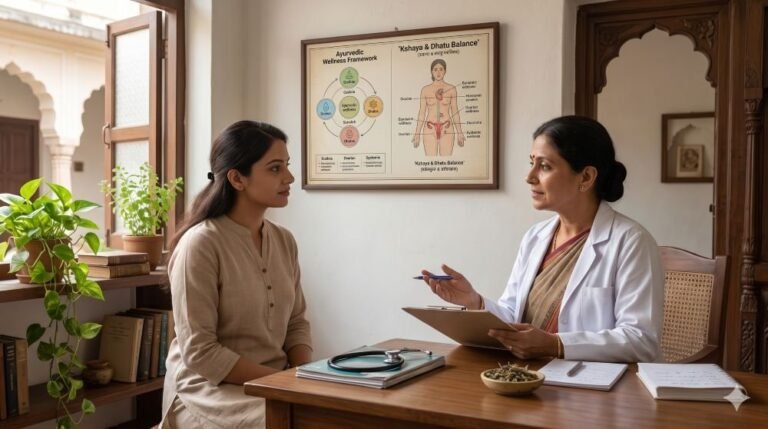
PCOS (Polycystic Ovary Syndrome) is a common hormonal condition in which the ovaries do not release eggs regularly, male hormones (androgens) may be somewhat higher, and there is often insulin resistance. Its symptoms differ in every woman. The link between PCOS and sexual health is seen at four levels: hormones, body image, mind and relationship.
In this article we will understand how PCOS affects desire and closeness, how the stress of planning a child affects the relationship, and what can be done through lifestyle and Ayurvedic care.
Key Takeaways
- PCOS affects about one in every 8 to 10 women; it is a common and manageable condition.
- Symptoms like weight, acne and excess hair can affect body image and confidence, and reduce desire.
- “Scheduled” intimacy for conceiving can turn closeness into a duty; couple communication is essential.
- Ayurveda understands PCOS through Kapha-Vata, Meda and Artava vitiation; lifestyle is the foundation of treatment.
What Does PCOS Do in the Body?
Normally, each month one egg matures in the ovary and is released. In PCOS, due to hormonal imbalance, many small follicles remain immature and ovulation becomes irregular. Because of insulin resistance, the body makes more insulin, which raises male hormones and brings a tendency to gain weight. As a result, symptoms such as irregular periods, acne, facial and body hair, thinning scalp hair, weight gain and difficulty conceiving may appear.
How Can PCOS Affect Sexual Life?
- Body image: shame due to weight, acne or hair; avoiding the husband’s gaze, keeping lights off.
- Desire: low in some women, normal in others; depends on mood and confidence.
- Mood: higher risk of anxiety and sadness, which reduce desire.
- Tiredness: insulin resistance, sleep problems.
- Pregnancy stress: intimacy only on ovulation days; closeness falls on other days; disappointment every month.
- Effects of medicines: some hormonal pills can affect desire in some women.
Symptoms
- Irregular or very delayed periods, sometimes none for months.
- Acne, excess hair on the face, chest or abdomen.
- Weight gain, especially around the abdomen; difficulty losing weight.
- Darkening of the skin on the neck or armpits (a sign of insulin resistance).
- Not conceiving.
- Tiredness, mood changes, low desire, shame about the body.
Causes
Modern View
- Genetic tendency (more likely if mother or sister has it).
- Insulin resistance.
- A sedentary life, excess sugar and refined flour, little sleep, stress.
- Changes in hormone balance (LH, androgens).
Ayurvedic View
Ayurveda has no single name for PCOS, but its symptoms match Artava Kshaya (scanty or delayed periods), Nashtartava (absent periods), Vandhyatva (infertility) and Meda Dushti (fat metabolism disorder). When Kapha and Meda increase, the Artava Vaha Srotas (channels carrying menstruation) get blocked, and the movement of Apana Vayu is disturbed. Weak Agni and “Ama” are considered the root of this blockage.
Ayurvedic Understanding
The sequence of Ayurvedic treatment is: Agni Deepana and Ama Pachana, Kapha-Meda reduction (exercise, diet, Udvartana, Lekhana herbs), Srotas Shodhana (Panchakarma when needed), and then Artava Janana (supporting menstruation) and Rasayana. Along with this, emphasis on happiness of mind, because worry and grief also disturb the menstrual cycle. Ayurveda sees the woman not as a “patient” but as someone regaining balance.
Psychological Understanding
Many women with PCOS compare themselves with society’s beauty standards and consider themselves “less of a woman.” Relatives’ remarks about facial hair or weight, and questions like “No good news yet?”, deepen this feeling. It brings a tendency to cover the body, get distracted and avoid closeness during intimacy. This is not “weakness”; it is a natural reaction that can change with support and understanding. Often the husband fully accepts his wife, but the wife herself cannot accept herself; at such times, recognising the inner critic’s voice and replacing it with a kinder one becomes an important part of counselling.
Common Myths
- “PCOS means never having children.” Fact: most women can conceive with proper care.
- “PCOS only happens to overweight women.” Fact: PCOS can occur in slim women too.
- “PCOS will get better on its own after marriage.” Fact: marriage does not change hormones; lifestyle and treatment are needed.
- “With PCOS, intimacy can’t be enjoyable.” Fact: with proper care, confidence and support, a satisfying married relationship is fully possible.
Which Tests Are Needed?
- Menstrual history, weight, BMI, waist size, BP.
- Pelvic ultrasound.
- Hormones: LH, FSH, testosterone, prolactin, thyroid.
- Sugar: fasting, HbA1c, insulin if needed; lipid profile.
- When planning a child, the husband’s semen report too.
Treatment / Management
- Lifestyle: the most effective foundation; even a 5 to 10% weight loss starts to regularise periods in many women.
- Symptom-based treatment: periods, acne, hair, conception.
- Care of the mind: counselling, support groups.
- Couple communication: keeping closeness alive even amid pregnancy stress.
- Ayurveda: Kapha-Meda reduction, Artava balance.
Modern Treatment, Explained
As needed, a gynaecologist or endocrinologist may consider hormone-balancing pills to regularise periods, an insulin sensitiser class medicine for insulin resistance, anti-androgen class treatment for excess hair and acne, and ovulation induction or IUI/IVF if needed for conception. If any medicine seems to affect desire or mood, tell your doctor; do not stop it on your own. Cosmetic options like laser for facial hair can also boost confidence.
Planning a Child and Closeness
Amid ovulation kits, dates and doctor visits, intimacy often becomes “work.” Pressure on the husband, disappointment in the wife, and sadness every time a period arrives. Things to keep in mind at this time: keep closeness on the other days of the month purely for love, keep talk about conceiving outside the bedroom, and make time to go out and laugh together. A child is the fruit of the relationship; the relationship itself is just as precious.
Making Friends With Your Body
For a woman living with PCOS, the biggest step is to see her body not as an enemy but as a partner. The body is signalling that it needs more movement, better nourishment, rest and less stress. Note small daily wins: today I walked 30 minutes, today I skipped sweets, today I slept on time. Instead of stepping on the scale every day, measure once a month, and pay attention to changes in energy, sleep and mood. Many women say real change began only when they started being kind to themselves.
The Husband’s Role
Never criticise or joke about your wife’s body or weight; instead, express appreciation and acceptance. Walking together, adopting healthy food at home, going to the doctor together, and standing by your wife against relatives’ questions, all of this strengthens both her confidence and your relationship. Remember, PCOS is not her fault.
Ayurvedic Herbs
Dosage and choice should be decided by a Vaidya after examination. Special caution if pregnancy is possible.
- Kanchanar Guggulu: classical for lumps and Kapha-Meda.
- Shatavari: Rasayana for Artava and women’s health.
- Ashoka, Lodhra: Artava balance.
- Fenugreek, turmeric, cinnamon: improve metabolism (in moderate amounts as food).
- Triphala: digestion and Kapha-Meda reduction.
- Ashwagandha, Brahmi: for stress and mood.
Diet
- Low glycaemic food: whole grains (jowar, bajra, oats), dal, legumes.
- Protein and vegetables in every meal.
- Less sugar, sweets, refined flour, packaged food and sweet drinks.
- Warm water, Agni-kindling spices like ginger, cumin and fenugreek.
- An early, light dinner; avoid daytime sleep (it increases Kapha).
Lifestyle
- 45 minutes of exercise daily: brisk walking, cycling, swimming; plus strength training 2 to 3 days a week.
- 7 to 8 hours of sleep at regular times.
- Stress management: meditation, hobbies, friends.
- Focus on improvements in waist size and energy rather than weight numbers.
Panchakarma
If Kapha and Meda are high, a Vaidya may suggest Udvartana (dry herbal powder massage), Vamana (therapeutic emesis, in suitable people), Virechana (purgation) and Basti (medicated enema). In special conditions, Uttara Basti by a specialist. Not mandatory for everyone.
Yoga and Pranayama
- Surya Namaskar, Bhujangasana, Dhanurasana, Baddha Konasana, Malasana (garland pose).
- Kapalbhati (not during periods or pregnancy), Anulom-Vilom, Bhramari.
Precautions
- Beware of claims like “PCOS gone forever”; it is a manageable condition.
- Avoid fasting or crash diets; they can disturb hormones further.
- If pregnancy is possible, take no herbs without advice.
- Do not stop ongoing medicines without your doctor’s advice.
- Results differ from woman to woman.
References
- Charaka Samhita, Chikitsa Sthana 30 (Yonivyapat, Artava Dushti).
- Sushruta Samhita, Sharira Sthana 2 (Artava Kshaya, Nashtartava).
- Charaka Samhita, Sutra Sthana 21 (Sthaulya, Meda).
Do’s and Don’ts
Do: exercise regularly, eat a low glycaemic diet, get tested, communicate with your husband, care for your mind.
Don’t: blame yourself, crash diet, take relatives’ remarks to heart, stop medicines on your own.
Counselling
In PCOS, counselling on body image, anxiety, pregnancy stress and the relationship helps a great deal. In individual or couple sessions, work is done on making peace with your body and regaining the joy of closeness. Everything you share is kept completely confidential.
Case Studies
Case 1: Shame About the Body
A woman in her late twenties had PCOS, weight gain and facial hair. After marriage she hesitated even to change clothes in front of her husband and avoided closeness. A gynaecologist’s treatment, daily walking, dietary changes, Kanchanar-Shatavari based Ayurvedic support under a Vaidya’s supervision and a few counselling sessions were started. Her husband also came to one session and said that what bothered him was not her appearance but her distance. In six months her weight came down a little, her periods began to regularise, and most importantly, her confidence returned. She said she now looks at herself in the mirror not with criticism but with patience, and celebrates even small improvements.
Case 2: Scheduled Intimacy
A couple around thirty had been trying for a child for two years. Intimacy happened only on the ovulation date each month, with distance on the other days. The husband began having erection problems and the wife lost desire. In couple counselling, they made closeness part of love again and kept talk of children outside the bedroom. PCOS treatment and lifestyle changes continued alongside. As stress reduced, the relationship improved, and in about a year they received good news. The wife said the biggest change was that their relationship again felt like “ours”, not just “for a child.”
Case 3: Mood and Tiredness
A working woman in her thirties with PCOS was troubled by constant tiredness, irritability and low desire. Tests found insulin resistance and vitamin D deficiency. With the doctor’s treatment, morning walks, a low glycaemic diet, regular sleep times and Ashwagandha-Brahmi based Ayurvedic support, her energy and mood improved in three to four months, and interest in closeness with her husband also returned. At the office she built a habit of walking a little every hour and adding more protein and vegetables to lunch. Her experience shows that in PCOS, small, consistent habits make a big difference.
When to See a Doctor / Sexologist
- No period for more than three months, or very irregular periods.
- Not conceiving despite a year of trying (six months at age 35 or above).
- Rapidly increasing hair growth, deepening voice.
- Body shame or sadness affecting the relationship and life.
- Very heavy bleeding or severe pain.
About Dr. Nikul Patel
Dr. Nikul Patel (BAMS) is an Ayurvedic physician at LifeCare Ayurveda and has been practising since 1999, that is, for 27 years. For PCOS-related sexual and emotional difficulties, he helps women regain confidence and balance through coordination with a gynaecologist, Kapha-Meda-Artava based Ayurvedic treatment, lifestyle guidance and confidential couple counselling.
FAQs
Does PCOS reduce desire?
In some women yes, mainly because of mood, tiredness, body image and pregnancy stress.
Can I have children with PCOS?
Yes, most women can conceive with lifestyle changes and proper treatment.
Does losing weight make a difference?
Yes, even a 5 to 10% weight loss improves periods and hormones in many women.
Can PCOS be cured permanently?
It is a long-term condition, but with proper care the symptoms can be well controlled.
Does Ayurveda help in PCOS?
Along with lifestyle, Ayurvedic Kapha-Meda reduction and Artava balance can be supportive; on a Vaidya’s advice.
People Also Ask
What is the difference between PCOS and PCOD?
In common usage both terms are used interchangeably; medically, PCOS is a broader hormonal syndrome.
Which exercise is best for PCOS?
A combination of regular aerobic exercise and strength training.
Can I take milk with PCOS?
Usually yes, in moderation; if acne is increasing, discuss with your doctor or Vaidya.
Conclusion
PCOS is not only about periods or weight, but also about a woman’s confidence, desire and relationship. With lifestyle improvement, proper medical treatment, Ayurvedic Kapha-Meda-Artava care, care of the mind and the husband’s loving support, many women live a balanced and satisfying married life. Results may differ from woman to woman.
Dr. Nikul Patel (B.A.M.S.)
307, 3rd Floor, Shalin Complex, Above Farki Lassi, Krishnabag Char Rasta, Maninagar, Ahmedabad – 380008
Timing: 10:00 AM to 1:00 PM and 3:00 PM to 6:30 PM | Saturday–Sunday: Closed
📍 Clinic Location — Google Maps
