
🌐 Read this article in other languages:
ગુજરાતી: પુરુષોમાં ઓછી કામેચ્છા (Low Libido): કારણો, તપાસ અને આયુર્વેદિક ઉપાય
हिंदी: पुरुषों में कम कामेच्छा (Low Libido): कारण, जांच और आयुर्वेदिक उपाय
Society holds a belief that a man “always has desire.” So when a man feels his desire is low, he tells no one and stays troubled inside. Often the wife feels, “He is no longer interested in me,” and silence enters the relationship. In reality, low libido is common in men too, and it has understandable causes.
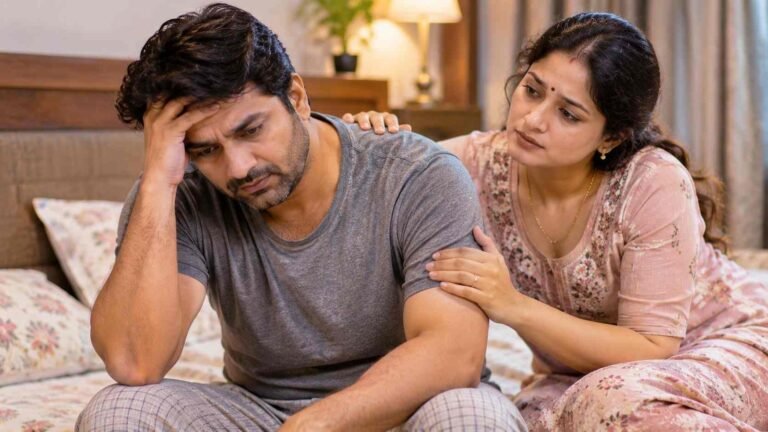
Low libido means that the desire, thoughts or interest in physical intimacy have become noticeably lower than before for a long period, and this causes distress to the person or the couple. The level of desire differs in everyone; it is considered a problem when the change is sudden or long-lasting and creates stress.
When desire drops, many men immediately start looking for a “strength medicine”, when in fact the body is signalling tiredness, lack of sleep, stress or some hidden illness. In this article we will understand why desire falls, when tests are needed, what can be done from the modern and Ayurvedic points of view, and how to talk about this with your partner. The aim is not to frighten, but to give the right understanding.
Key Takeaways
- Low desire and erection problems (ED) are different, even if they sometimes occur together.
- Stress, tiredness, lack of sleep and relationship problems are the most common causes.
- Testosterone, thyroid, prolactin and some medicines also have an effect.
- Ayurveda considers Ojas, Agni and enthusiasm of the mind as the basis of desire.
How Does Desire Work?
Libido is not just a game of hormones. The brain, hormones, body energy, emotions, the relationship with the partner and the surroundings all come together to create desire. Testosterone supports desire, but without a happy mind, rest and a feeling of closeness, desire can stay low even when hormones are adequate. Likewise, even if the relationship is good, desire gets suppressed when the body is tired.
Symptoms
- Fewer thoughts or fantasies about physical intimacy.
- No interest even when the partner takes the initiative.
- Finding excuses to avoid intimacy.
- Fewer morning erections (in hormonal causes).
- Tiredness, irritability, lack of enthusiasm, sadness.
Causes
Modern View
- Stress and tiredness: work pressure, financial worry, long hours.
- Sleep: too little sleep, snoring with pauses in breathing (sleep apnoea).
- Hormones: testosterone deficiency, underactive thyroid, raised prolactin.
- Long-term illnesses: diabetes, kidney or liver problems, obesity.
- Medicines: antidepressants, some blood pressure or prostate medicines, some hair-loss medicines with hormonal effects. Do not stop them on your own.
- Addictions: alcohol, tobacco, recreational drugs.
- Psychological: sadness, anxiety, bad past experiences, shame about the body.
- Relationship: fights, anger, lack of trust, boredom from the same routine.
Ayurvedic View
Ayurveda links desire with “Harsha” (joy) and “Utsaha” (enthusiasm). Desire falls when Ojas decreases, Agni becomes weak and Vata or Kapha increases.
- Vata dominant: worry, little sleep, a lean body, unstable desire.
- Pitta dominant: anger, overwork, alcohol; desire is present but irritability is high.
- Kapha dominant: heaviness, laziness, excess fat, too much sleep; desire does not awaken.
Ayurvedic Understanding
Acharya Charaka says that the Vrishya (desire and strength enhancing) state comes not only from medicine but also from a loving partner, fragrance, music, season-appropriate food and a happy mind. For Shukra Dhatu to be nourished, it is first necessary to improve Agni and remove “Ama” from the body. After that, Rasayana (rejuvenating) and Vajikarana herbs work better.
Psychological Understanding
Many men do not put stress into words; its effect shows in sleep, appetite and desire. In times of sadness or hopelessness, the brain chemicals linked with “pleasure” become less active and desire falls. If there has been an erection problem in the past, the mind itself starts avoiding intimacy, so that embarrassment does not happen again. This is not a diagnosis, but a pattern worth understanding.
Difference in Desire: A Common Situation in Couples
Often the problem is not “low desire” but a difference in desire between husband and wife. One may want intimacy several times a week and the other less often. There is nothing “wrong” in this. What is needed is open conversation, understanding each other’s needs and finding a middle path. Pressure or taunts do not increase desire; they reduce it.
Changes in Desire With Age
At 20 to 30, desire is usually higher; after 40, some gradual change comes. This is natural. But even at 40 or 50, desire disappearing completely in a healthy man is not normal. At this age, work responsibilities, children’s education, care of parents and one’s own health often all come together. According to Ayurveda, middle age is the time of Pitta and after 60 of Vata; so adjusting diet and routine according to age keeps both body and desire balanced. Rather than giving up by saying “it’s age now”, it is better to get a health check-up.
Which Tests Are Needed?
- History: since when, sudden or gradual, sleep, stress, medicines, addictions, state of the relationship.
- Weight, blood pressure, physical examination.
- Blood: morning testosterone (twice if needed), thyroid, prolactin, sugar, haemoglobin, vitamin D and B12.
- A sleep study if there is snoring and daytime sleepiness.
Treatment / Management
- Treat the root cause: thyroid, sugar, weight, sleep.
- Medicine review: if a medicine is affecting desire, the doctor considers alternatives.
- Counselling: individual or couple, for stress and the relationship.
- Ayurveda: Agni Deepana, Ama Pachana, then Rasayana-Vajikarana.
Modern Treatment, Explained
If tests show a proven testosterone deficiency, a specialist may consider hormone replacement, but this requires regular blood tests and monitoring of the prostate and haemoglobin. Hormone treatment can reduce sperm production, so if you are planning a child, discuss this specifically. If prolactin is high, its cause is investigated and treated specially. If sadness or anxiety is the main issue, there is coordination with a psychiatrist. Do not take medicines sold as “hormone boosters” on your own.
The Partner’s Role
When the husband’s desire falls, the wife often blames herself. Remember, the cause is mostly tiredness, stress or health, not a lack of attraction. Talking at a calm time without blame, going for walks together, sharing housework and responsibilities, and keeping small moments of closeness (holding hands, hugging), all of this slowly helps bring desire back.
Small Steps You Can Start at Home
- Sleep schedule: sleep and wake at the same time every day; screens off before bed.
- Morning walk: 20 to 30 minutes in sunlight; good for both mood and hormones.
- Alcohol break: stop alcohol completely for at least one month and see the difference.
- Stress diary: each night, write three lines about what felt heavy today; the mind feels lighter.
- Small moments of closeness: hugs, holding hands, listening to music together, without any expectation of intimacy.
- Abhyanga: sesame oil massage before bathing 2 to 3 times a week, especially in Vata Prakriti.
These steps are not a substitute for treatment, but in many men they make a difference to energy and mood within two to four weeks, and make later treatment more effective.
Ayurvedic Herbs
Dosage and choice should be decided by a Vaidya after examination.
- Ashwagandha: reduces stress, strengthening, Vata pacifying.
- Kaunch Beej: Vajikara; uplifts the mind.
- Safed Musli: Vrishya, strengthening.
- Shatavari: cooling Rasayana; in Pitta Prakriti.
- Gokshura: good for the urinary and reproductive system.
- Trikatu, Chitrak: for Agni Deepana when Kapha and Ama are high (on a Vaidya’s advice).
Diet
- Milk (at night, with turmeric or cardamom), ghee in moderation, almonds, dates, figs.
- Pumpkin seeds, sesame, walnuts: zinc and good fats.
- Dal, legumes, eggs (if you eat them), green vegetables.
- Avoid: excess sugar, fried food, eating out daily, alcohol.
- In Kapha Prakriti, less heavy and sweet food, warming spices (ginger, black pepper) in moderation.
Lifestyle
- 7 to 8 hours of sleep at regular times.
- At least 150 minutes of exercise a week; along with some weight training.
- A boundary between work and home; no office email at night.
- A weekly “couple time”: outings, meals, conversation together.
- 15 to 20 minutes in sunlight (vitamin D).
Panchakarma
If Kapha and Ama are high, Udvartana (herbal powder massage) and Virechana (purgation); if Vata is high, Abhyanga (oil massage) and Basti (medicated enema). Vajikarana herbs are considered more effective after purification. Panchakarma is not mandatory for everyone.
Yoga and Pranayama
- Surya Namaskar (sun salutation), Dhanurasana (bow pose), Ustrasana (camel pose).
- Kapalbhati (skull shining breath, in Kapha; with advice if you have heart disease or high BP).
- Bhramari (humming bee breath), meditation.
Precautions
- Do not stop ongoing medicines without your doctor’s advice.
- Do not take “testosterone boosters” or hormone injections on your own.
- If sadness comes with thoughts of self-harm, seek help immediately.
- Even Ayurvedic medicines only in pure form and the right dosage.
- Results differ from person to person.
References
- Charaka Samhita, Chikitsa Sthana 2 (Vajikarana Pada).
- Charaka Samhita, Sutra Sthana 17 (description of Ojas).
- Ashtanga Hridaya, Uttara Tantra 40.
Do’s and Don’ts
Do: sleep and exercise, get tested, talk to your partner, use stress-reducing measures, seek expert advice.
Don’t: hide it out of shame, take advertised medicines, try to create a “mood” with alcohol, blame your partner.
Counselling
In low desire, couple counselling often proves the most effective. It works on the way you communicate, each other’s expectations, stress management and ways to rebuild closeness. Everything you share in counselling is kept completely confidential.
Case Studies
Case 1: Work Overload
An IT professional in his thirties worked 12 to 14 hours a day and slept at 2 a.m. For a year his desire had almost disappeared and distance with his wife had grown. Reports were almost normal; vitamin D was low. With a sleep schedule, work boundaries, morning walks, vitamin D correction and Ashwagandha based support under a Vaidya’s supervision, both energy and desire changed within three months. At first he thought it must be “some major disease”, but he realised his body was only asking for rest and regularity. His wife also said they now have tea together in the evening and talk about their day, which had stopped for months. These small changes brought warmth back to the relationship.
Case 2: Thyroid
A man in his forties complained of tiredness, weight gain and low desire. Tests showed an underactive thyroid. With the physician’s treatment along with diet, exercise and Ayurvedic Agni Deepana treatment, his body’s energy gradually returned, and with it his desire. What relieved him most was that the problem was not a “weakness of the mind” but a treatable condition of the body. He continued his thyroid medicine regularly as his doctor advised, and Ayurvedic treatment ran alongside as support. At the six-month follow-up, his weight had also come down a little.
Case 3: Silence in the Relationship
A couple in their late thirties had constant fights over family issues. The husband’s desire had dropped completely; no physical cause was found. In couple counselling they learned the right way to express anger and began spending time together. In two to three months, desire returned along with warmth in the relationship. The most important step in counselling was talking in the language of “we” instead of blaming each other. They decided to keep one evening a week only for themselves, with no family discussion. The husband said his desire had never “gone”; it had been buried under anger.
When to See a Doctor / Sexologist
- Reduced desire for more than three months that causes distress.
- Along with it, extreme tiredness, weight change, breast swelling, less beard growth.
- Headache with changes in vision (a prolactin-related cause is possible).
- Sadness, hopelessness or thoughts of self-harm.
- A sudden change after starting a new medicine.
About Dr. Nikul Patel
Dr. Nikul Patel (BAMS) is an Ayurvedic physician at LifeCare Ayurveda and has been practising since 1999, that is, for 27 years. For low libido in men, he examines all aspects, stress, sleep, hormones and the relationship, and guides through Vajikarana-Rasayana based Ayurvedic treatment and confidential couple counselling.
FAQs
What is the difference between low desire and ED?
In low desire, interest itself is low; in ED, there is difficulty with erection despite desire. Both can occur together.
Is it normal for desire to fall with age?
Some decrease is natural, but a sudden or large decrease needs examination.
Should everyone get a testosterone test?
The doctor advises it if there are symptoms; a test done in the morning is considered more reliable.
Is Ashwagandha safe for everyone?
It is useful for many, but with thyroid conditions, pregnancy or other medicines, a Vaidya’s advice is necessary.
How do I explain it to my wife?
At a calm time, honestly tell her it is related to tiredness or health, not a lack of attraction; going to the doctor together is better.
People Also Ask
Does depression reduce desire?
Yes, sadness and hopelessness directly affect desire; treating them often improves desire too.
Does losing weight raise testosterone?
In obese men, weight loss often improves testosterone.
Which food increases desire?
There is no single “magic” food; a balanced diet, zinc and protein, and good sleep help.
Conclusion
Low libido in men is a matter not of shame but of attention. Mostly it is a signal of tiredness, stress, sleep, hormones or the relationship. With proper tests, lifestyle improvement, Ayurvedic Agni-Ojas care and open communication with the partner, desire gradually returns in many men. Results may differ from person to person.
Dr. Nikul Patel (B.A.M.S.)
307, 3rd Floor, Shalin Complex, Above Farki Lassi, Krishnabag Char Rasta, Maninagar, Ahmedabad – 380008
Timing: 10:00 AM to 1:00 PM and 3:00 PM to 6:30 PM | Saturday–Sunday: Closed
📍 Clinic Location — Google Maps
