
🌐 Read this article in other languages:
ગુજરાતી: બાળકો પછી નિકટતા: માતા-પિતા બન્યા પછી પતિ-પત્નીનો સંબંધ કેવી રીતે જીવંત રાખવો
हिंदी: बच्चों के बाद निकटता: माता-पिता बनने के बाद पति-पत्नी का रिश्ता कैसे जीवंत रखें
“Now we only talk about the children: homework, fees, tuition, medicines, vacations. At night the child sleeps between us, and in the morning the rush starts again. I can’t remember the last time the two of us sat alone together.” Many couples whose children are between three and twelve can relate to this. The love is there, but the relationship as husband and wife has been buried under the role of “parents.”
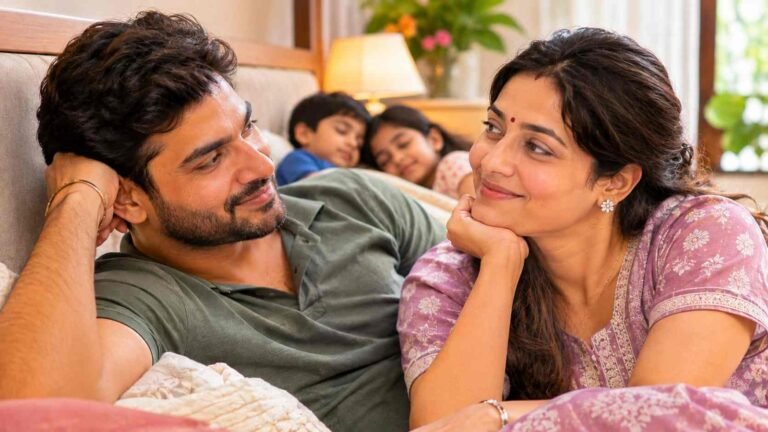
Intimacy after kids means maintaining the emotional and physical connection between husband and wife in the years after becoming parents. Even after the first months following childbirth (which we covered in a separate article), new challenges come as children grow: fatigue, privacy, an unequal load of responsibilities, and a constant lack of time.
In this article we will understand why intimacy fades after children, why it matters for the children too, and practical, Ayurveda-based ways to keep the relationship alive even in a busy family.
Key Takeaways
- Intimacy fading after children is very common; it is not a failure of the relationship.
- Fatigue, lack of privacy, an unequal load of responsibilities and the “only parents” role are the main causes.
- A strong relationship between parents gives children an example of security and love.
- An Ayurvedic daily routine, care of energy and small but regular couple time nourish the relationship.
Why Does Intimacy Fade After Children?
Raising children needs time, energy and attention, all three. By the end of the day both are often so tired that they only want to sleep. If young children sleep in the same room or bed as the parents, there is no privacy. Along with this, the household’s “mental load,” the responsibility of keeping all the family’s lists in mind, often falls more on one partner, bringing resentment and distance. Slowly husband and wife become “team managers,” not lovers.
Symptoms
- Conversation only about children, home and expenses.
- Almost no time alone together.
- No intimacy for months, or only in a hurry.
- Irritation over small things, arguments about responsibilities.
- Seeing each other “only as parents.”
Causes
Modern View
- Fatigue and lack of sleep: children’s routines, job, housework.
- Lack of privacy: sharing a room with children, joint family.
- Unequal load of responsibilities: more burden on one partner, resentment towards the other.
- A whole life centred on the children: no thought of time for the couple.
- Body changes and confidence: weight, fatigue, age.
- Financial pressure: education costs, home loans.
- Disagreements about parenting: arguments over discipline, studies, mobiles.
Ayurvedic View
According to Ayurveda, constant rushing, irregular meals, incomplete sleep and worry increase Vata, which brings fatigue, irritability and reduced desire. Ojas, the essence of vitality, gets depleted in this state. Charaka Samhita speaks of the “Trayopastambha,” the three pillars of life: Ahara (diet), Nidra (sleep) and Brahmacharya (a balanced married life). When sleep and diet are disturbed, the pillar of married life weakens too. Ayurveda considers a loving and balanced married life part of health in the householder’s life.
Ayurvedic Understanding
The Ayurvedic approach works at three levels: first, restoring energy: regular sleep, timely meals, Abhyanga and Rasayana; second, steadying the mind: Pranayama, meditation and Medhya herbs; and third, making space for the marriage: time, setting and communication. The classical teachers say that a cheerful mind and a loving partner are themselves the best Vajikarana; so care of the relationship and routine comes before medicine.
Psychological Understanding
Many parents believe that making time for themselves is “selfish.” In fact, children learn love, respect and communication by watching their parents’ relationship. When children see their parents giving each other time, laughing, and resolving arguments calmly, they feel secure. On the other hand, children also sense constant tension and a cold relationship. So caring for the couple relationship is a gift to the children too.
Resentment from an unequal load of responsibilities is intimacy’s biggest enemy. A partner exhausted from handling everything all day does not open up to intimacy at night. When both truly share responsibilities, space is made for both energy and love.
Challenges by the Children’s Age
- 1 to 5 years: night waking, co-sleeping, constant attention; fatigue is highest.
- 6 to 12 years: school, tuition, activities; evenings are a rush.
- Adolescence: children stay up late, privacy becomes a challenge again; arguments over studies and mobiles.
The solution differs at each stage, but the principle is the same: consciously create time and space for the couple.
Practical Ways to Keep the Relationship Alive
- Children sleeping separately: gradually, according to age, build the habit of the child sleeping in their own bed or room.
- A daily 15-minute “couple tea”: after the children sleep, without phones, just the two of you.
- One evening a week: go out with the help of grandparents, relatives or a trusted person.
- A genuine division of responsibilities: make a list and decide who handles what.
- A lock on the door and a privacy rule: teach children, according to age, to knock before entering.
- Small signals during the day: a hug, a loving message, a thank you.
- One or two short breaks a year: just for the two of you, even if only one night.
Arguments and Intimacy
Disagreements about raising children are natural. But when arguments stay unresolved, they enter the bedroom too. Try to resolve arguments not in front of the children but at a calm time, using “I feel this way” language instead of accusations like “you always.” Making up and apologising after an argument, even if the children see it, teaches them the art of repairing a relationship.
Support from Grandparents and Family
In Indian families, grandparents or close relatives can be a big support. If the children stay with them one evening a week, the children get love and the couple gets time. In a joint family, it is also fine to speak respectfully with elders and explain the couple’s need for a little privacy. Many elders understand this themselves; someone just needs to say it calmly.
Treatment / Management
- Couple communication: open talk about responsibilities, expectations and intimacy.
- Lifestyle: sleep, timely meals, exercise.
- Couple counselling: work on resentment, arguments and communication.
- Check physical causes: thyroid, anaemia, low mood, hormones.
- Ayurveda: Vata pacification, Rasayana, Abhyanga, Medhya herbs.
Modern Treatment, Explained
The main treatment here is couple counselling and lifestyle improvement. If fatigue is very high, the doctor checks for anaemia, thyroid or vitamin deficiency, and suggests iron or vitamin supplements if needed. If low mood or anxiety is high, there is coordination with a psychiatrist. Problems like erection difficulty, pain or dryness need separate treatment.
Common Myths
- “We’ll have time once the children grow up.” Waiting increases distance; make small time now.
- “Making time for ourselves is selfish.” A strong couple relationship benefits the children too.
- “Less intimacy means less love.” Usually the cause is fatigue and lack of time.
The Role of Both Husband and Wife
In many families the housework and childcare fall mostly on the mother. When the father takes responsibility fully as his own, not just “helping,” such as school preparation, doctor visits or the night routine, space opens in the mother’s mind for intimacy. And when both see each other as “husband and wife” beyond “parents,” appreciate each other and keep up small romantic gestures, warmth stays in the relationship.
Ayurvedic Herbs
Dosage and choice should be decided by a Vaidya after examination.
- Ashwagandha: reduces fatigue and stress, strengthening.
- Shatavari: Rasayana for women.
- Chyawanprash: classical Rasayana for energy and immunity (on advice in diabetes).
- Brahmi, Jatamansi: sleep and peace of mind.
- Kaunch seed: enthusiasm, Vajikarana.
Diet
- Timely, warm, fresh meals; do not skip meals.
- Milk, dates, almonds, seasonal fruits, green vegetables.
- Do not finish your meal with the children’s leftovers; eat a full meal for yourself.
- Reduce dependence on tea and coffee for energy.
Lifestyle
- A regular bedtime for the children, so the evening is saved for the couple.
- 7 to 8 hours of sleep; take turns resting in the morning.
- Walk or do yoga together.
- Abhyanga for each other once a week.
- A little time for your own hobbies.
Panchakarma
When fatigue and Vata are high, a Vaidya may suggest Abhyanga (oil massage), Shirodhara (oil stream on the forehead), Padabhyanga (foot massage) or Basti (medicated enema), followed by Rasayana therapy. Not mandatory for everyone.
Yoga and Pranayama
- Surya Namaskar: for energy.
- Viparita Karani, Balasana: to reduce fatigue.
- Anulom-Vilom, Bhramari: peace of mind.
- 10 minutes of Yoga Nidra before sleep.
Precautions
- Fatigue with weight loss, deep sadness or sleeplessness: get a health check-up.
- Violence or humiliation in arguments: seek help immediately.
- Beware of advertised “energy” or “desire” boosting medicines.
- Results differ from couple to couple.
This article is for general educational information. If there is deep resentment, constant arguments or long distance in the relationship, it is most appropriate to seek confidential advice from a qualified couple counsellor or sexologist.
References
- Charaka Samhita, Sutra Sthana 11 (Trayopastambha: Ahara, Nidra, Brahmacharya).
- Charaka Samhita, Chikitsa Sthana 2 (Vajikarana: a cheerful mind, a compatible partner).
- Ashtanga Hridaya, Sutra Sthana 2 (Dinacharya).
Do’s and Don’ts
Do: small daily couple time, share responsibilities, arrange privacy, appreciate each other, counselling when needed.
Don’t: wait saying “we’ll see later,” argue in front of the children, blame each other, neglect the relationship.
Counselling
For relationships after children, couple counselling works on dividing responsibilities, resentment, communication and rebuilding intimacy. Many couples find a new direction within a few sessions. Everything you share is kept completely confidential.
Case Studies
Case 1: The Child Sleeps in Between
A couple in their thirties had a six-year-old son who still slept between them. For two years intimacy had almost stopped, and irritation between them had grown. In counselling they made a plan to gradually get their son used to sleeping in his own bed: stories, a small night lamp and praise. Along with 15 minutes of tea together daily without phones. In two months their son began sleeping in his own bed, and the couple said they “got their evenings back.” The wife said that even more than intimacy, she loved the time to talk calmly with her husband.
Case 2: An Unequal Load
A working mother in her late thirties handled her job, two children and the house, while her husband only “helped.” She resented him, and her desire was completely gone. In a couple session they made a list of responsibilities; the husband took the children’s morning preparations and the Saturday shopping fully as his own. On a Vaidya’s advice she was also given Ashwagandha-Shatavari based support. In three months her fatigue and resentment reduced, and interest in intimacy returned. She said, “More than medicine, I needed my husband’s support.”
Case 3: A Teenager and Arguments
A couple in their forties argued constantly about their fifteen-year-old son’s mobile and studies. The arguments reached the bedroom, and there had been no intimacy for months. In counselling they learned to first agree on parenting rules between themselves and then present them to their son with one voice. As the arguments reduced, they started walking together again. In a few months warmth returned to the relationship. The husband said he realised that the greatest gift for their son is his parents’ calm and respectful relationship with each other.
When to See a Doctor / Sexologist
- No intimacy for months, and both are troubled by it.
- Constant fatigue, low mood, sleep problems.
- Deep resentment about responsibilities and frequent arguments.
- Physical problems like erection difficulty, pain or dryness.
- Growing emotional distance in the relationship.
About Dr. Nikul Patel
Dr. Nikul Patel (BAMS) is an Ayurvedic physician at LifeCare Ayurveda and has been practising since 1999, that is, for 27 years. For married relationships after children, he guides parents to revive their relationship as husband and wife through confidential couple counselling, Ayurvedic care for routine and energy, and medical tests when needed.
FAQs
Is it normal for intimacy to decrease after children?
Yes, very common; with conscious effort the relationship can come alive again.
When should a child sleep separately?
According to the child’s age and readiness, gradually and lovingly; you can consult a paediatrician.
What if we simply have no time?
Even 15 minutes a day is a good start; regularity matters more.
How do we get privacy in a joint family?
Time out together, family help with childcare and a room rule all help.
How does Ayurveda help?
Sleep, diet, Abhyanga and Rasayana bring back energy, which is the foundation of intimacy.
People Also Ask
Does the parents’ relationship affect children?
Yes, children learn love, respect and communication from their parents’ relationship.
What is the “mental load”?
The invisible responsibility of keeping all the household’s lists and planning in mind.
How do we reconnect after an argument?
First make up calmly and apologise; then touch and time.
Conclusion
It is natural for intimacy to fade after children, but the relationship need not be neglected. A genuine division of responsibilities, small but regular couple time, privacy, respectful resolution of arguments, an Ayurvedic routine and care of energy, and counselling when needed help parents come close again as husband and wife too. Results may differ from couple to couple.
Dr. Nikul Patel (B.A.M.S.)
307, 3rd Floor, Shalin Complex, Above Farki Lassi, Krishnabag Char Rasta, Maninagar, Ahmedabad – 380008
Timing: 10:00 AM to 1:00 PM and 3:00 PM to 6:30 PM | Saturday–Sunday: Closed
📍 Clinic Location — Google Maps
